

Can Data Centers Bring Joy?
Yes, if.

Diesel generators. Water. Land use. Noise. Horizon blight.
That was the list in 2019. In comment periods, county hearings, headlines in papers. The same five things from communities in different corners of the world. Singapore, the Netherlands, New Zealand, Italy. Even a few towns in the US.
Notice what isn’t on the list. No carbon. No climate. No politics. Every item is local, physical, and sensory: something you can smell at the fence line, hear from a porch, see against a ridge, or fail to find in a well.
People weren’t objecting to an idea. They were itemizing damages.
For two decades the industry had an answer for this, and it worked. Tax revenue. Some jobs. Free wi-fi. A replenishment project in the region. Permission had a market rate, and companies paid it.
Then the price stopped being the point. In 2019 Amsterdam and Singapore both stopped issuing permits outright. And cloud demand was already on course to multiply the footprint tenfold. AI hadn’t arrived yet.
So we designed for yes, please.
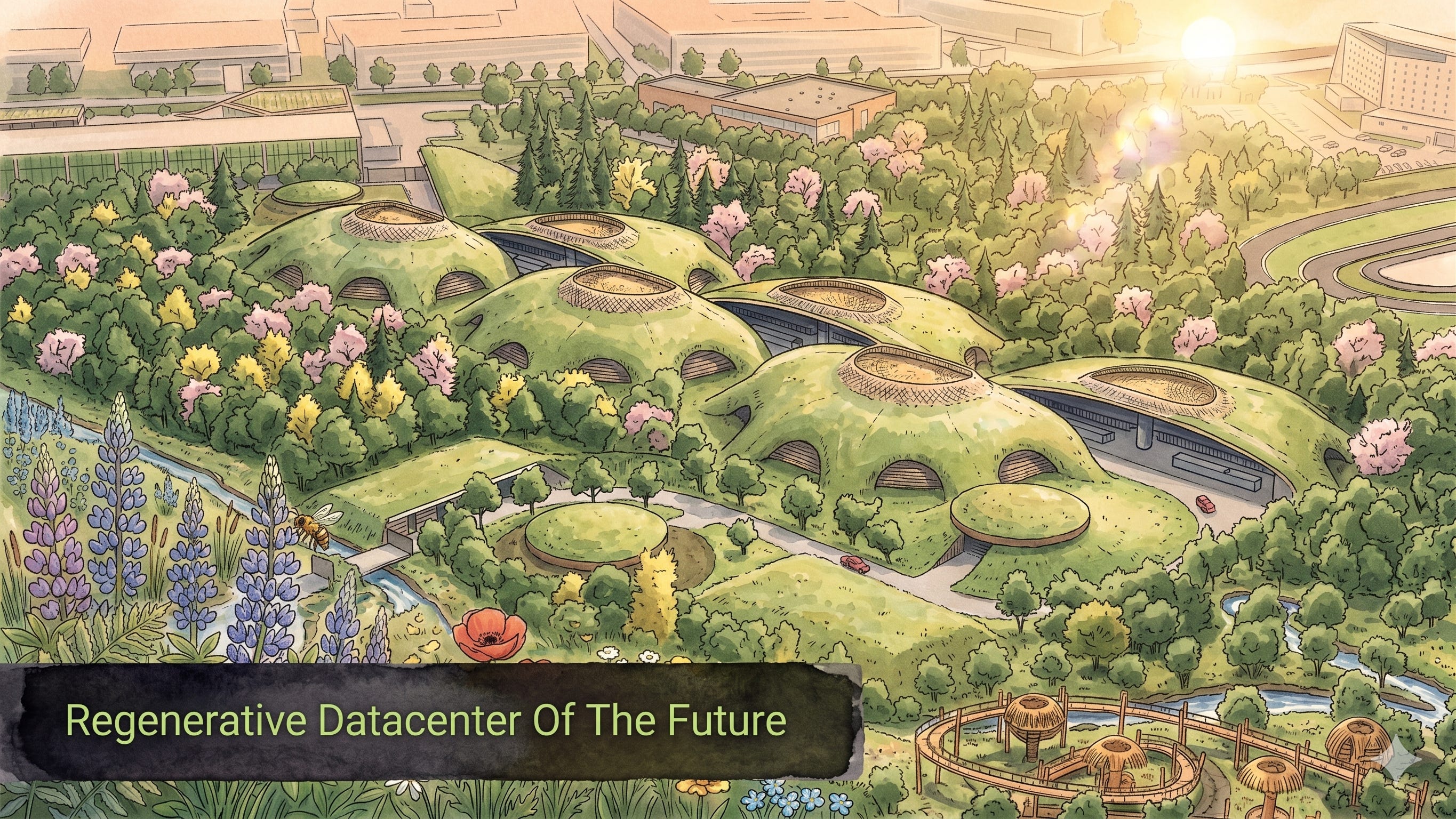
Not for tolerance. Not for a narrow approval on a split vote. We set out to build something a community would want on its land whether or not anyone needed a data center: waste heat piped to greenhouses instead of exhausted through noisy fans, water returned cleaner than it arrived, no diesel, a site that produced more than it consumed. We designed out NIMBY to create PIMBY — Please in my backyard.
It worked the way we hoped. Show people the designs, walk them through what the building actually does for the place it sits in, and the room changes. For the communities, it changes from resignation or resentment to relief and reception.
And it changes for the builders too.
Veterans of this industry — people who had spent twenty and thirty years building the big windowless boxes — reviewed our plans and told us they would be proud to build it. Not interested. Not supportive. Proud.
Angus Fletcher writes about emotions as information, feedback. Fear tells you that you have no plan. Anger tells you that you’re stuck with only one. You don’t argue your way out of anger — you make a second plan.
Data center designers and engineers have had essentially one plan for a generation. A plan that put them in conflict with almost every town they entered. And every ounce of ingenuity in a brilliant, deeply technical field went into making that one plan marginally cheaper and faster.
The regenerative design was the first real new plan. The pride wasn’t a mood produced by pretty pictures. It was the specific relief of finally having somewhere else to go. To have a vision of the future they could be proud of with others, not despite others.
Communities had one plan too. Fight, or lose. Refusal was the only instrument they had.
The Regenerative Datacenter can be the industry’s “Joy Pivot” with communities, and the communities’ Joy Pivot with the industry. We need it to be both.
Pressure without pride doesn’t produce better buildings. It produces the same building in a friendlier county. Communities have pushed for twenty years and mostly what moved was the map.
Pride without pressure doesn’t produce buildings at all. I can tell you exactly how that goes. Hundreds of people who wanted to build something, and one no at the top.
Piece by piece, our design is making its way into the specifications at Microsoft and, more so, in new companies. Good work finds a way forward. Push and pull — that’s the balance that works.
This is #30 in my weekly Innovating Out Loud series. AI was used as a research, writing, and arguing partner. All the ideas and final edits are mine. Say it Ugly, Build it Better. Onward!
Data Centers: The Tower or The Wall

They chose the cheapest land they could find — flat, remote, far from anyone likely or able to object. Then they raised a hall with no windows, as big as two aircraft carriers, surrounded by concrete and a black steel fence. It drinks from the county’s water. It pulls from the county’s grid. It returns a number on a tax form. Inside, it computes. Few in…
Exactly! Our communities need help to survive and grow. Our state and county infrastructure is old, our borough & town pockets are stretched to the maximum, and our household budgets are being depleted to maintain any thoughts of the American Dream. And yet, data centers are locally and nationally feared as a horrific solution to ease our financial challenges. We need our corporate visionaries to step-up, take action, and put their focus and financial support to CHANGE this narrative and BUILD these data centers of the future to SAVE our communities.